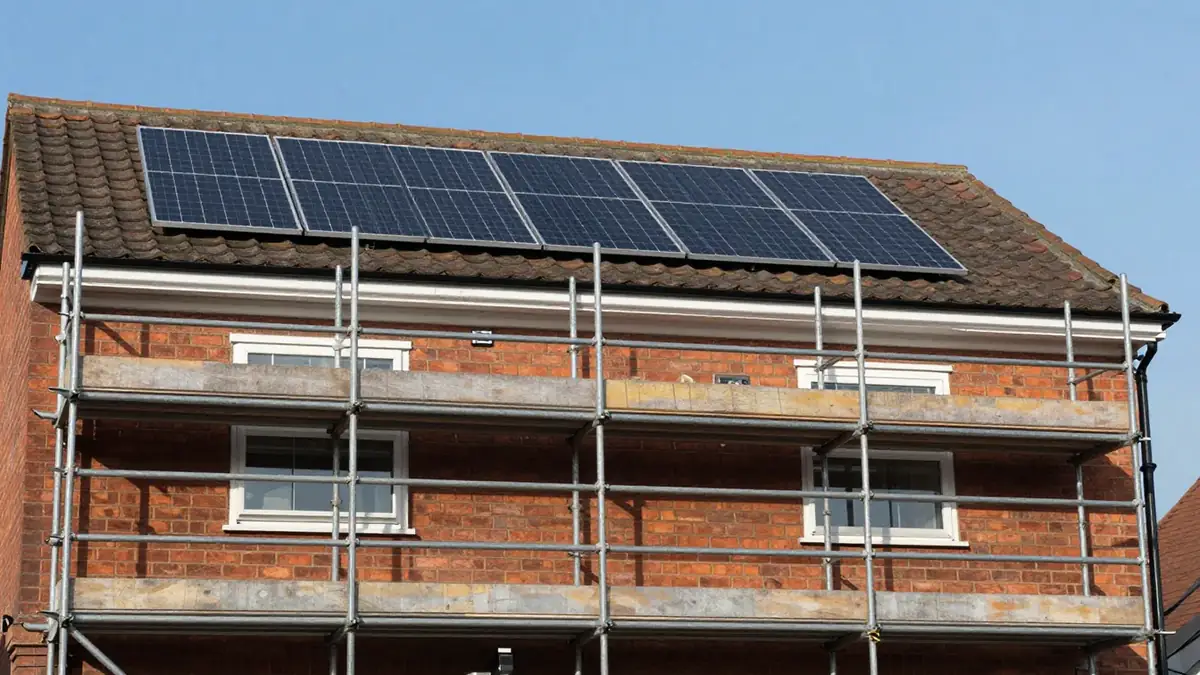
Scaffolding often appears as its own line on a solar quote. It can look like an add-on that sits apart from the panels. However, it exists for a reason, and it is worth understanding before you compare prices.
This guide explains why scaffolding is usually needed, what a good scaffolding line should cover, and how to compare it between installers. We do not quote a price, because we could not find a sourced one.
Why scaffolding is there at all
Roof work is one of the most dangerous jobs in construction. The Health and Safety Executive says almost one in five deaths in construction work involve roof work. It names falls from roof edges, through fragile roofs and through fragile rooflights as the main causes (HSE).
Because of that, the rules on access are firm. HSE states that sloping roofs require scaffolding to prevent people or materials falling from the edge. Edge protection must also be fitted at the eaves of any roof. On terraced properties, it must cover the rear as well as the front.
There is one exception. For work of short duration, with tasks measured in minutes, HSE says properly secured ladders and roof ladders may be used. A full solar installation takes much longer, so most pitched roofs will need scaffolding.
Why it is shown as a separate line
Scaffolding needs depend on your building. A bungalow, a three-storey terrace and a detached house all need different amounts. That may be why some installers show it as a separate line.
Installers may also hire scaffolders in, so the cost may come from a subcontractor. MCS tells homeowners that the quote should be clear and give a full breakdown of what they are buying. It also says the installer should tell you about any subcontractors involved (MCS).
So an itemised line is not a red flag by itself, although a missing line is a reason to ask questions.
What a scaffolding line should cover
A clear quote answers these points in writing. Because it is easier to settle these before you sign, ask if any are missing.
- Whether scaffolding is included in the total or added on top.
- Which elevations are covered, such as front only or front and rear.
- Edge protection at the eaves, and any access for the roof.
- How long the scaffolding stays up, and what happens if weather delays the job.
- Who erects it, and whether they are a subcontractor.
- Whether any permission needed to put scaffolding on a pavement or shared land is the installer’s job.
How to compare the line fairly
Prices for the whole job are not comparable if one quote includes scaffolding and another leaves it out. First, find each quote’s total. Then check whether scaffolding is inside it.
Next, put every quote on the same basis, because only then can you compare. Add any extra scaffolding line to the total, then divide by the system size in kWp. Our solar quote checker does this in your browser. For a wider method, see how to compare solar quotes step by step.
A low panel price with scaffolding left out may not be cheaper at all. In the same way, a high scaffolding line may reflect a tall or awkward building, and not a mark-up. Ask the installer to explain it.
What the cost data does and does not tell you
DESNZ publishes median installation costs based on MCS data. The cost it measures includes the generation equipment, the cost of installing and connecting to the supply, and VAT where it applies. It does not list scaffolding on its own (DESNZ).
So treat scaffolding as part of the overall installed price when you read the national figures. Our guide to solar panel cost puts those figures in context. Prices vary, so get written quotes.
Check the rest of the quote too
Scaffolding is one line among many, and the others still matter. Our guide to what is in a solar quote lists the others, such as the inverter, mounting kit, electrical work and certificates.
Other lines can connect to scaffolding. If the roof needs repairs or bird-proofing, the time the scaffold is up may be a convenient moment to do it. Read our post on solar panel bird proofing before you decide. The equipment you choose changes the work on the roof too, so see string inverters, microinverters and optimisers.
Planning, timing and local differences
Check the planning position early, because it can delay the job. Our post on planning permission for solar panels explains the common cases, including listed buildings and conservation areas.
Timing matters as well. Which? says that once the scaffolding is up, the panels could be installed in less than a day, so the scaffolding sets part of the schedule. Our guide to how long installation takes shows how that fits into the schedule.
Building types differ across the country, so local context helps, although every building is different. See what installers in London charge for one regional example, or read the guide to solar quotes in the North East.
The short version
Scaffolding is there because HSE says sloping roofs require scaffolding to stop people or materials falling from the edge. Expect it as a separate line, and expect it to vary with your building. Ask each installer what it covers, how long it stays and who provides it, then compare totals on the same basis.