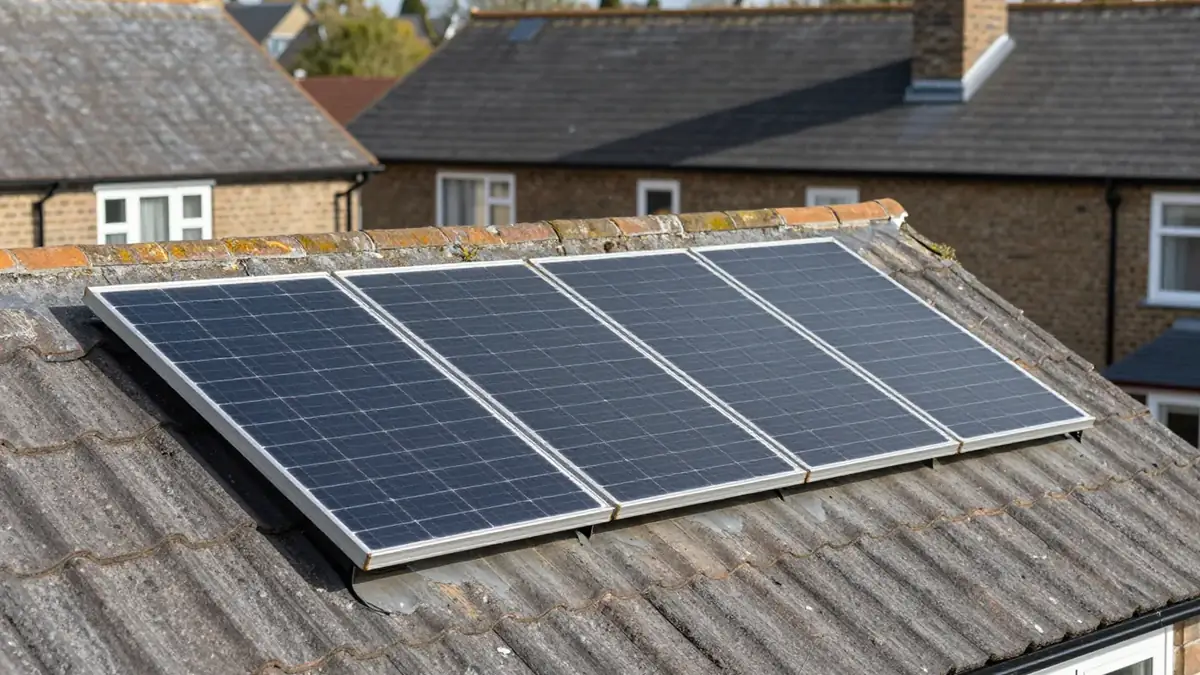
Every solar panel loses a little output as it ages. This is called degradation, and it is normal. What matters is how fast it happens and what the warranty promises if it happens faster.
What solar panel degradation means
Degradation is the slow fall in the power a panel produces. Which? says panels degrade gradually over time.
However, degradation is not the only reason output falls. Which? says a drop in generation is most likely caused by weather, dirt or a change such as new shading, so rule those out first.
How fast do panels lose output?
The best public figure comes from the US National Renewable Energy Laboratory. Its review assembled nearly 2,000 degradation rates, measured on modules and whole systems, from 40 years of field testing. The median value was 0.5% a year.
At that rate, a panel keeps roughly 88% of its first-year output after 25 years. That is our own arithmetic, not a figure from the review. Real panels vary, so treat it as a guide only, not a promise.
Your panels may do better or worse. Also, Which? says the expected degradation sits on the panel datasheet. To find it, search online using the make and model shown on your MCS certificate.
What a performance warranty promises
A power output warranty is a promise from the manufacturer. It says the panel will still produce a set share of its original output after a set time. It is also separate from the product warranty, which covers faults in the panel itself.
Which? publishes a table of popular brands. Also, product warranties in that table run from 12 years to 30 years. Power output guarantees at 25 years range from 84.8% for Canadian Solar and SolarEdge to 92% for REC. However, two brands, Aiko and Jinko, guarantee output at 30 years instead.
For a brand to earn a Which? Recommended label, it must offer at least a 12-year product warranty. It must also offer a minimum 25-year power output warranty. So these terms are a useful benchmark when you read a quote.
The inverter has a shorter life
The panels are not the only part that ages. Which? says panels can carry warranties of up to 20 or 25 years, but inverters are not expected to last as long. It tells owners to expect to replace the inverter at some point.
In the Which? owner survey, the inverter was the most common problem. MCS says the panels themselves can last over 25 years, but the inverter may need replacing in that time. So ask what the inverter warranty covers and for how long.
Warranties your installer should explain
A solar job usually brings several separate warranties. Keep them straight, because each one has a different owner. For example, the panel maker will not fix a poor roof fixing.
- Product warranty from the panel maker, for faults in the panel.
- Power output warranty from the panel maker, for degradation.
- Inverter warranty from the inverter maker.
- Workmanship warranty from your installer, for the installation itself.
Which? says any faults caused by poor workmanship should be covered, free of charge, by your installation warranty. A workmanship warranty is only as good as the company behind it, though. Our guide to checking a solar installer explains what to verify first.
What if your installer stops trading?
A guarantee means little if the company has gone. The RECC explains what to do. First, look through your paperwork for a deposit or workmanship warranty insurance policy. Then check whether your MCS certificate names the insurance provider.
Next, contact that provider to see if you can make a claim. The RECC says it holds no consumer details, so it cannot tell you whether insurance is in place. Either way, keep your paperwork safe for the whole warranty period, because you will need it.
Keep the paperwork for later
Warranties matter again when you sell, so keep the certificates, guarantees and datasheets together. Our guide to selling a house with solar panels lists what to hand over.
Good records also help if output drops. For instance, note your generation regularly so you can spot a change. Our post on maintaining and cleaning solar panels shows how. The panel direction matters for output too, so see east-west versus south-facing panels when you judge a drop in generation.
Damage is a different matter. Because a warranty covers faults, not every kind of harm, read solar panels and home insurance to see how the two fit together.
Compare warranties before you sign
Put the warranty terms side by side when you compare quotes. Look at the length, the percentage guaranteed and who stands behind each promise. Our guide to comparing solar quotes shows how to do this.
Quotes differ by area, so you may want to see what homeowners in the North West are quoted and how quotes look in the South East. Prices vary, so get written quotes.
When you are ready, ask for matched quotes from MCS installers. We are a comparison service, not an installer, so we pass your enquiry to certified firms.