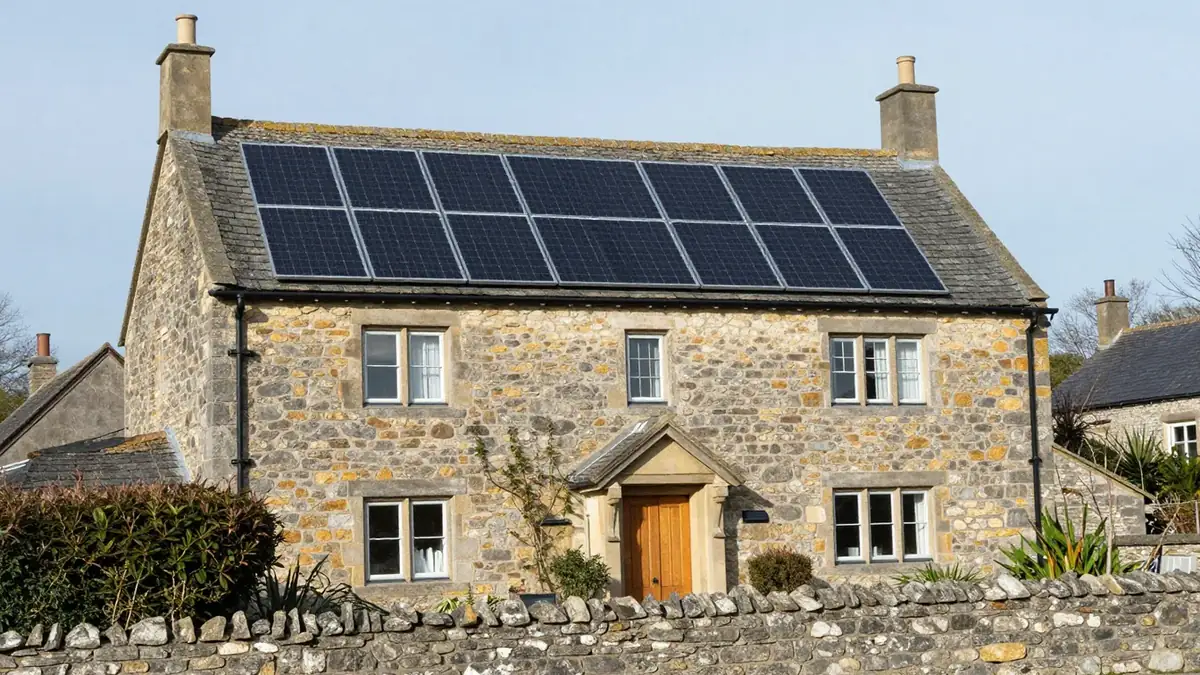
Many UK homeowners can fit roof solar panels without a planning application. However, the rules differ across the four nations, and some homes face extra limits. This guide sets out the main rules from official sources, so you can ask your installer the right questions.
Rules change, and councils can add their own limits. Treat this as a starting point, because your local planning authority has the final say.
England: the permitted development rules
In England, solar equipment on a house can be installed under “permitted development” rights. That means you can fit it without a planning application if you meet set conditions.
The Planning Portal lists the main roof limits. These are the rules in place before 27 August 2026, which you can still follow until a transitional period ends on 27 August 2027. On a pitched roof, panels should not sit above the highest part of the roof, excluding the chimney. They should also project no more than 200mm from the roof slope or wall surface.
On a flat roof, the highest part of the equipment cannot sit more than 600mm above the highest part of the roof. Flat roofs on protected “Article 2(3)” land need extra care, because you must apply to the council for prior approval. The Planning Portal says that land includes national parks, the Broads, Areas of Outstanding Natural Beauty, conservation areas and World Heritage Sites.
New wall rules from 27 August 2026
The Planning Portal says the right changed on 27 August 2026, and you can follow either the old or the new rules until 27 August 2027. For houses, the new rules say that on a wall, balcony or roof enclosure next to a highway, solar PV should not protrude more than 0.2 metres. On any other wall, balcony or roof enclosure, the limit is 0.4 metres. For plug-in solar, the same page says no part of the equipment should go on a wooden wall, balcony or enclosure, or any exterior clad in timber.
These wall limits matter if an installer proposes a wall-mounted array.
Listed buildings and conservation areas
Historic homes face extra rules. In England, the Planning Portal says you must not install panels on a building within the grounds of a listed building, or on a site designated as a scheduled monument.
In a conservation area, England adds a rule about walls. You must not fit panels to a wall that fronts a highway. For houses, the wording from August 2026 also covers a balcony or roof enclosure that fronts a highway.
If your home is a listed building, assume you need permission. Because of that, speak to your council before you ask for quotes. Our checklist of questions to ask an installer works well for that first conversation.
Wales, Scotland and Northern Ireland
Wales follows its own guidance. The Welsh Government says panels should sit below the ridgeline and project no more than 200mm from the roof or wall surface. In a conservation area or World Heritage Site, it says you need planning consent for panels on principal or side elevation walls that you can see from the highway. For a listed building, it says you need planning permission and will likely need listed building consent.
In Scotland, the Scottish Government guidance says solar equipment on a dwellinghouse must not protrude more than 1 metre from a wall, roof plane, ridge or chimney. It also says these rights do not apply in conservation areas. For flats, the guidance says a building warrant may be required.
For Northern Ireland, I could only find a supplier’s summary. Power NI says you only need planning permission if your home is listed or in a conservation area. Since that is not an official source, confirm it with your local council.
Flat roofs, scaffolding and the wider project
A flat roof can seem an easy spot for panels. Yet England sets specific limits for flat roofs, as shown above.
Our guide to solar panels on a flat roof covers the practical side, such as tilt frames and weight. Planning is only one part of that decision.
Scaffolding is not a planning matter, but it affects your costs. Read what scaffolding adds to a solar quote before you compare prices.
How planning fits into a real project
Planning is one step among several. Your installer also surveys the roof, agrees a design and deals with your network operator. You can read how that works in G98 and G99 applications explained.
For a sense of the whole sequence, see how long installation takes. Planning checks come first, so raise them early.
Local conditions vary, because conservation area rules apply only to homes inside one. Our page on solar quotes in London shows what comparing quotes looks like in one region. See also solar quotes in the south west of England.
What to do before you accept a quote
First, find out whether your home is listed or in a conservation area. Your council’s website will tell you. Second, ask each installer in writing whether your design counts as permitted development.
Third, put planning in the scope of every quote. A good quote says who checks the rules and who pays if you need an application. When you compare solar quotes, look for that line in each one.
If you are ready to collect quotes, you can request quotes through our form. Solar Panel Price Check is not an installer. We pass your enquiry to MCS-certified companies, and planning advice stays with your council.