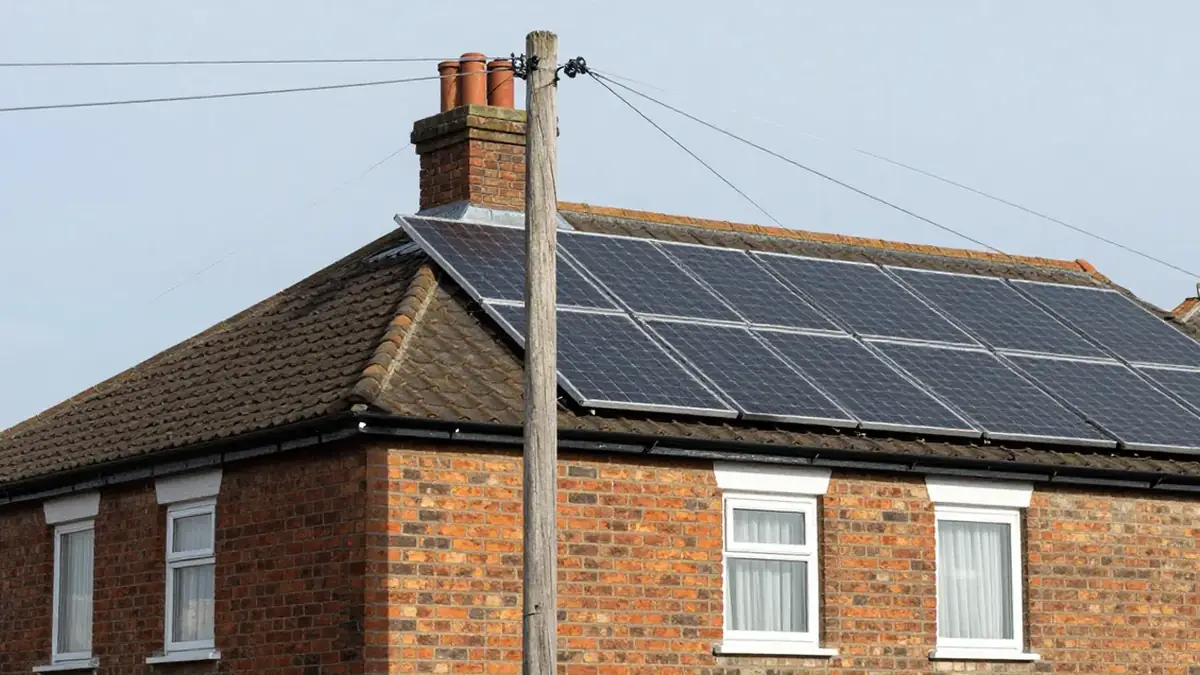
Every home solar system connects to the local electricity network. The network owner is called the distribution network operator, or DNO. It needs to know about your system, and sometimes it must approve it first, because the network has limits.
Two Energy Networks Association documents set the rules, called G98 and G99. This guide explains which one applies, who does the paperwork and what timescales the DNOs give.
G98 and G99 in plain terms
G98 is the simpler route. National Grid says it applies to micro-generating plant with an aggregate capacity of 16 A (3.68 kW) per phase or less, where the equipment meets the ENA’s G98 recommendation for fully type-tested micro-generators (National Grid G98).
G99 is the next route. It applies to generation and storage rated above 16 A (3.68 kW) per phase, or equipment that does not meet the current G98 (National Grid G99).
In short, G98 means notify, and G99 means apply. SSEN says most domestic solar PV systems have a total generation capacity of 3.68 kW or less, so G98 suits those. Larger systems fall under G99.
How the rating is worked out
The rating is not the panel total. For solar, the DNO therefore uses the inverter’s continuous steady-state rating. National Grid gives two examples. A single-phase 3 kW inverter is 13.04 A, which is inside the G98 limit. A single-phase 4 kW inverter is 17.39 A, which is just over the 16 A line.
The rating is also an aggregate. National Grid says the rating of micro-generation is the sum of each unit at the premises. Adding panels to an existing system is one case where the total grows. National Grid also applies G99 to generation and storage above the 16 A line. So an extension can push a home from G98 into G99 even if the new part is small.
Also, our guide to how many solar panels you need explains why panel kWp and inverter kW are different numbers.
What happens under G98
Under G98 you can install first and tell the DNO afterwards, although the notice is still required. National Grid says you may install and commission the generation before providing information, and that you must then return a G98 installation document with an operation diagram within 28 days.
SSEN says much the same. It states that for installations rated under 3.68 kW, the installer should notify it after the install, by completing a commissioning confirmation form on your behalf (SSEN).
MCS gives a more cautious message for homeowners. It says you must register your system with your DNO, and that you will need to notify the DNO before your installer begins work, with details of the system type and capacity. It adds that in some cases the installer can do this for you (MCS).
Because the advice differs, ask your installer which approach they follow, and get the date in writing.
What happens under G99
Under G99, MCS says prior permission to connect has to be granted before installation. National Grid says smaller installations, up to 17 kW single phase or 50 kW three phase, have a simplified application. For a fully type-tested unit, the applicant completes form A1-1. The installer carries out the commissioning tests.
Some DNOs also run a Fast Track route. SSEN describes three categories of small generation installation. The first covers units with a registered capacity of 3.68 kW and a design capacity of up to 7.36 kW. The second covers a total registered capacity of up to 7.36 kW, where an export limit may be needed to hold export to 3.68 kW. SSEN says it aims to respond to Fast Track applications within 10 working days.
Note that this target is for Fast Track only. We found no sourced figure for a standard G99 application, so we do not give one. Timescales vary by DNO and by how busy the local network is.
Export limits and network capacity
Sometimes the network cannot take all the power you want to export because local capacity is limited. SSEN says an export limitation scheme can limit what you send to the grid. It may be cheaper than paying for network upgrades, and it may mean a faster connection. SSEN also says you do not need one if your total generation is 3.68 kW or less, which covers most domestic solar systems, though you should check with your provider.
Likewise, Electricity North West makes the same point for systems under 3.68 kW (ENWL). Still, a limit may apply to you, so read the application carefully.
Who applies and who pays
Normally your installer applies or notifies. Because that should be part of the job, your quote should say so. If it does not, ask. Our list of questions to ask an installer includes this one.
The DNO is not the same as your supplier. For systems under 30 kW, SSEN says your supplier arranges the export meter point number. So there are two separate contacts, one with the network and one with your supplier.
In addition, for payment on exported power, see our guide to the Smart Export Guarantee.
Planning, installation time and selling a home
The DNO process is separate from planning, although both can affect timing. Check the planning rules for your roof, as our post on planning permission for solar panels explains. The DNO step also sits inside the wider schedule, so see how long installation takes.
Paperwork matters later too, so keep the DNO confirmation with your other records. Our post on selling a house with solar panels covers what else to keep. If your roof is flat, panel layout and inverter choices may differ, as discussed in solar panels on a flat roof.
Regional notes
Because the DNO that covers you depends on where you live, check your postcode with your installer. Read our regional pages on solar quotes in Scotland and what installers in the South East charge for local context.
Using this when you compare quotes
When you compare quotes, therefore, check each one names the inverter rating, the grid route and who applies. Our guide to comparing solar quotes shows how to line them up. If you want help getting matched quotes, our free quote form goes to the operator, who matches homeowners with MCS-certified installers.
We are not an installer or a DNO, so for your own case, ask your installer and read your DNO’s current guidance.