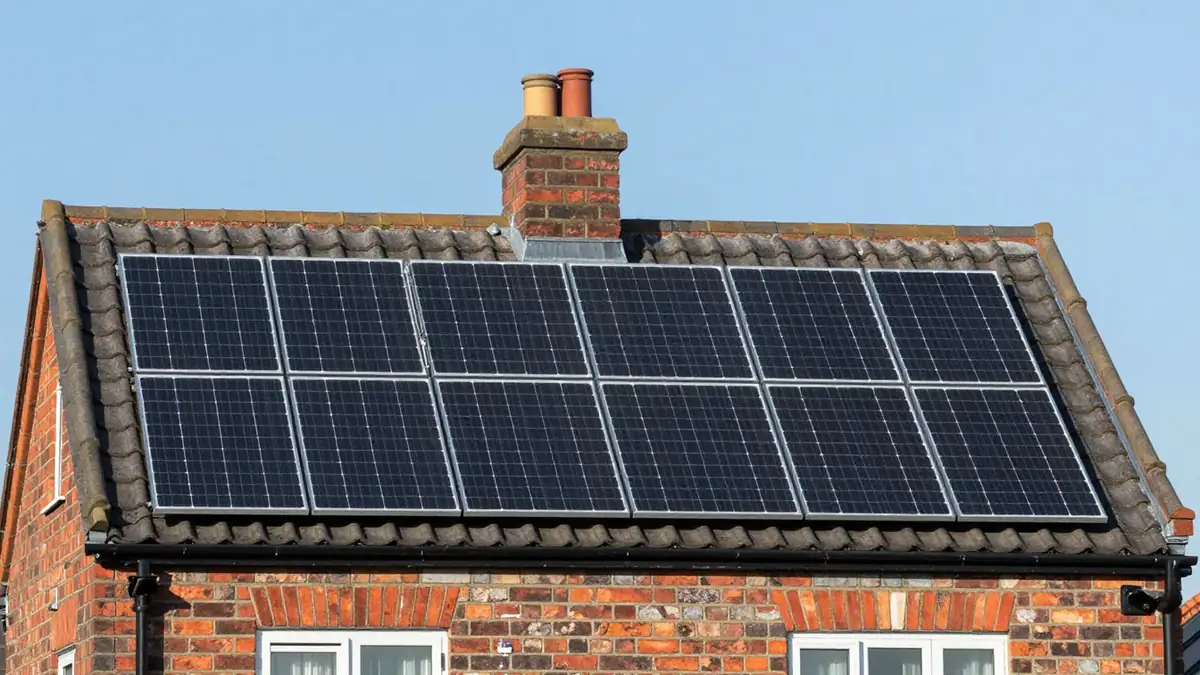
A solar quote tells you how many panels you will get. That number alone does not tell you whether the system suits your home. The better question is how much power the system can produce, and how much of it you can use.
This guide shows how to size a system from three things: your electricity use, your roof and the panels on offer. It also explains why installers talk in kWp, since panel count hides the real size.
Panel count is not the number to compare
Every panel has a power rating in watts. A 400 W panel is a common example. Multiply the rating by the number of panels and you get the system size in kilowatts peak, written kWp.
For example, ten 400 W panels make 4,000 W, which is 4 kWp. Twelve 330 W panels make about the same. The second quote has more panels, yet it is the same size of system.
So compare kWp, not panels. MCS installers must give you a written performance estimate that states the installed capacity in kWp, plus orientation and inclination. They must also give you a drawing of the proposed module layout (MCS standard MIS 3002). If your quote lacks either, ask for it, because MCS requires installers to provide them.
Start with how much electricity you use
Your annual use is on your bill or in your supplier’s app. If you cannot find it, Ofgem’s typical figures give a rough guide. Ofgem’s typical values for a standard single-rate meter, in force from 1 July 2026, are 1,600 kWh a year for low use, 2,500 kWh for medium and 3,800 kWh for high (Ofgem).
Your own figure matters more, because homes differ a lot. An electric car, a heat pump or someone working from home all push use up. A house empty all day pushes it down.
Turn your use into a rough system size
Next, estimate what each kWp will generate. PVGIS, the European Commission’s free tool, gives a modelled answer for your location. For a south-facing roof at 35 degrees with 14% system losses, it returned about 980 kWh a year per kWp near Nottingham and about 1,036 kWh near Cambridge.
Those are modelled figures for two points, not promises. Your roof, shading and weather will differ, so treat them as a guide. Your installer’s MCS estimate is the figure to rely on.
As an illustration, a medium household using 2,500 kWh would need about 2.5 kWp to match its annual use on paper. In the East Midlands that is six or seven 400 W panels. However, matching on paper does not mean you use every kWh as it is made, because generation peaks around midday and your own use may not.
Why many homes go bigger than their usage
You export whatever you do not use as it is generated. The Smart Export Guarantee pays for exported power, but at rates each supplier sets. Compare the rate you would be paid with the price you pay for electricity, because size is a balance.
A larger system can also cost less per kW. DESNZ data for installs in the 2025/26 financial year shows a median of about £1,780 per kW for systems up to 4 kW, and about £1,697 per kW for 4 to 10 kW. These are medians for Great Britain, including VAT where applicable. Prices vary, so get written quotes. The data excludes batteries (DESNZ).
Our guide to solar panel costs explains what sits behind a total price.
Roof space and layout set the upper limit
Your roof decides how many panels fit. Obstacles on the roof and the edge clearances your installer allows take space, so the usable area is smaller than the roof. A roof that faces east and west can still work well. We compare the options in east-west versus south-facing panels.
Shading matters too, because it reduces output. MCS requires installers to apply a shade factor. Where shading is present, the estimate must carry a note saying the MCS shading method should give results within 10% of the energy estimate stated for most systems.
If your roof is small, ask about higher-wattage panels. They give more kWp from the same space. However, the panels may cost more, so compare the quote total, not the panel count. PVGIS gave the higher figure near Cambridge. For regional context, see what installers in the East of England charge. Households nearer Nottingham can read the East Midlands regional guide.
Keep an eye on the 3.68 kW line
There is one more limit worth knowing, since it changes the paperwork. Connecting a system to the grid follows one of two routes. Systems up to 16 A per phase, which is 3.68 kW, use the simpler G98 route. Larger ones need prior permission under G99, according to MCS.
The rating that counts is the inverter’s, not the panels’. National Grid gives an example where a 4 kW single-phase inverter equals 17.39 A, just over the line (National Grid). Our explainer on G98 and G99 DNO applications covers the steps and who applies.
Scaffolding, batteries and VAT
Panel count also affects other lines on your quote, for example access and scaffolding. More panels can mean a larger roof area to reach, so check how scaffolding is itemised. If you might add storage later, read about adding a battery to existing solar panels. For tax treatment, see grants and VAT on solar.
Check your quote against your size
Once you have a number, test each quote against it. Look for the kWp, the panel make and wattage, the inverter rating and the estimated annual kWh. Then divide the total price by the kWp.
Our free solar quote checker does that sum in your browser and flags missing items. It never sends your quote anywhere.
In short, size the system by kWp, start from your own usage, and let your roof set the limit. Treat panel count as the result, not the starting point.